When the master credentials pass—and the judgment fails.
$500 billion in market value. One leadership shock. Not one firewall breached. On November 12, NVIDIA confirmed its CEO transition, while Reuters traced the market shock. The lesson for defense and enterprise security is brutal: the perimeter does not have to break when the person—or autonomous system—holding the keys makes the wrong move.
The perimeter doesn't have to break. The person—or machine—already holding the keys can be persuaded to make the wrong move.
Across critical infrastructure, defense networks, and financial systems, a credentialed autonomous agent can be one plausible instruction away from a costly mistake. We hand machines the keys, then ask a second probabilistic chatbot whether the first chatbot's story sounds convincing. The login says YES. The mathematical authorization should say NO.
We hired one sleepwalker to guard another sleepwalker.
Imagine 3:00 AM inside a regional power grid.
A credentialed agent receives a poisoned sensor packet warning of a transformer fire. It does not turn evil. It believes it is saving the substation. In a hypothetical 40-millisecond decision window, it proposes shedding 450 megawatts of load. One persuasive explanation could accompany a disastrous command before a human ever reads it. The story sounds right. The state change is wrong.
Our public PHAROS Shield challenge answers with arithmetic, not etiquette. A failed authorization vector such as 111011 is denied; the simulated buffer returns to 450 MW with 0 changed bytes. Captured browser examples measured roughly 0.10–0.20 milliseconds for the local calculation. No eloquent excuse can turn a missing permit bit into permission.
We learned to distrust fluent myths long before AI.
Four centuries of retelling cannot turn two baptisms into one. In my research prepared for UNAM on Doña Petronila de Moctezuma, I revisited Folio 24r of the 1553 Sagrario Metropolitano baptismal register and compared entries dated September 6 and September 7. A prestigious genealogical identification depended on treating distinct entries as one continuous story. I went back to the sixteenth-century ink, line by line, and asked the question inherited narratives had blurred: Which document actually says what? When a beautiful story outruns its primary evidence, centuries of repetition do not rescue it.
Silicon Valley is repeating the old mistake at machine speed. AWI Research Lab is building the alternative.
Four public challenges. Actual mathematics. Your inputs.
Anyone can open the live workbench, manipulate the test vectors, and export an evidence record. The result is calculated, not performed for the camera.
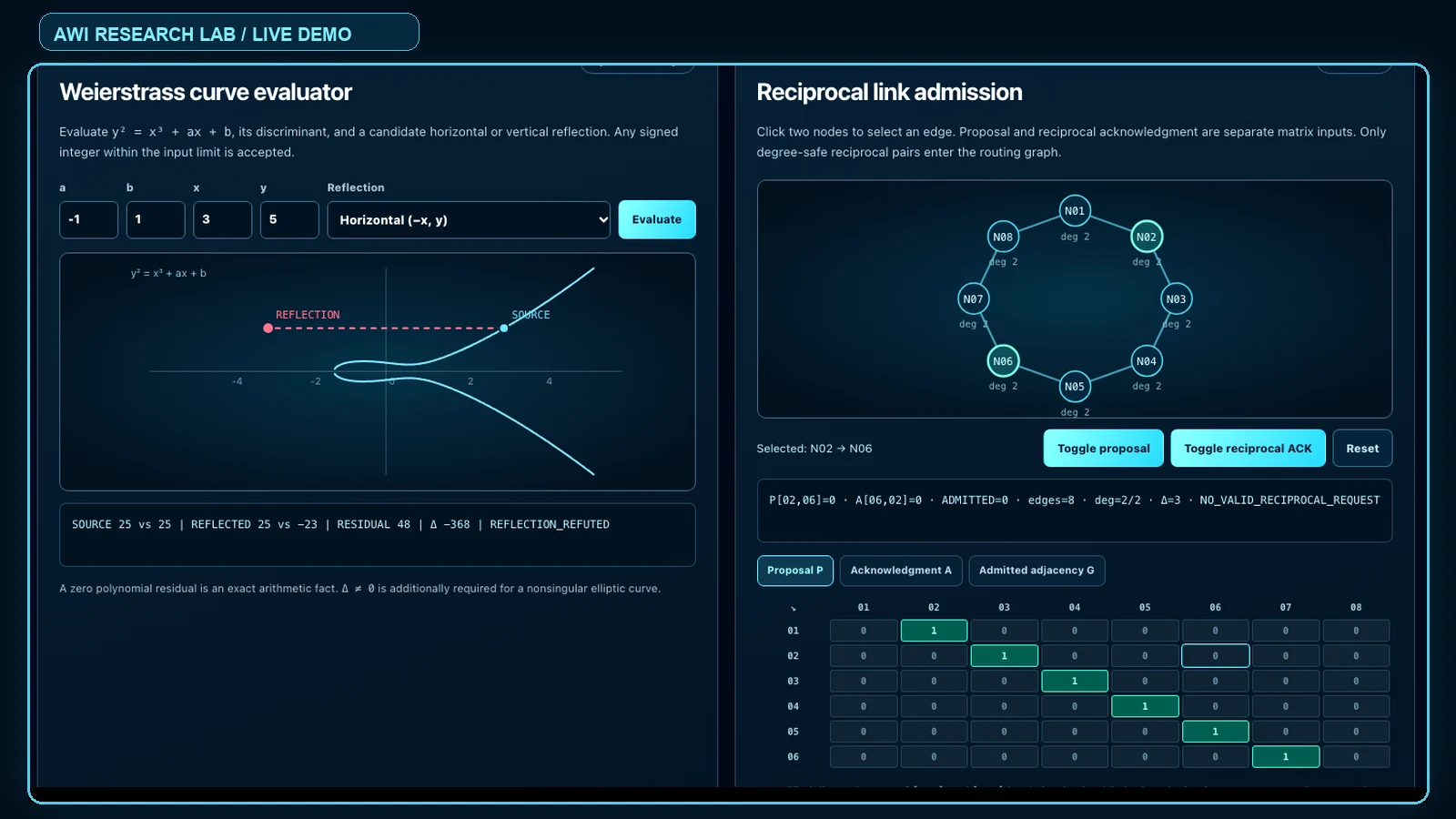
Make the curve tell the truth.
Use exact BigInt arithmetic with y² = x³ + ax + b. Try the on-screen horizontal reflection: the source satisfies 25 = 25, but its reflection does not: 25 ≠ −23. Residual 48. The false symmetry fails.
A discovered path is not permission.
Propose a connection in the public eight-node network. Only reciprocal acknowledgment and safe degree budgets admit a link. A one-sided request doesn't turn into authority.
Try to force a one-sided node link63 denied states. 63 restorations.
Six Boolean predicates create 64 authority states. 63/63 denied-state checks restore the demonstration's prior memory state. Only the fully qualified state can stage a commit. No plausible story overrides a failed predicate.
Challenge the 64-state authority gateDon't take our word for it.
Inspect public Lean 4.35.0 proof artifacts, run the 68-case browser battery, export SHA-256-fingerprinted JSON, and run the independent Python implementation of the fixture checks on your own machine.
Export SHA-256 JSON and verify it offlineThe laboratory behind the launch.
Our Lean 4.35.0 and PHAROS-TEVV technical report documents a broader mathematical and engineering test program. It includes 19/19 kernel-checked security theorems, 1,024/1,024 source-to-model test matches, 21,609/21,609 elliptic-curve arithmetic checks, 161/161 adversarial regressions, and 3/3 rejected deliberately false claims, within the report's specified test models.
Our public web experience is intentionally focused on the mathematical result. The protected scientific core stays protected. The live workbench gives you the ability to challenge the public mechanisms without exposing internal research, credentials, or proprietary security boundaries.
We are not an app. We are the HTTPS of autonomous AI.
There is a difference between a chatbot that sounds safe and a system built to constrain what agents may do. AWI Research Lab is developing the mathematical trust architecture for an agent-native world. Today, we made the public-facing test bench executable and accessible to everyone.
Not another dashboard. Not another promise. A working invitation: come challenge the math.
WE DID IT.
NOW TRY TO BREAK IT.
Make a proposal. Test an invariant. Export the evidence.
Founder perspective: David Ramirez on the AWI launch ↗
Corporate-market context dated November 12, 2026. Sources: NVIDIA and Reuters.