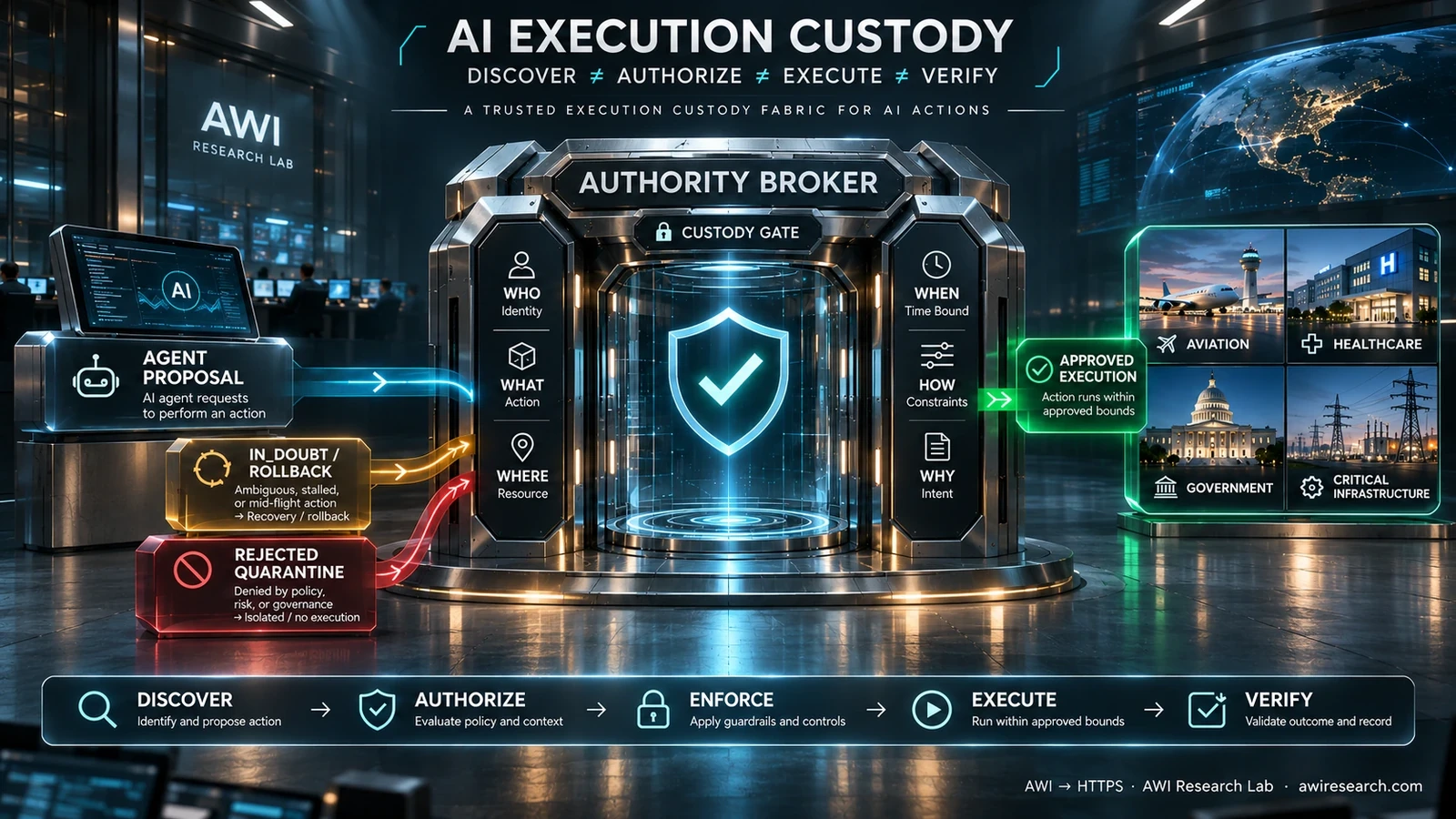
AI Execution Custody is the independent control and evidence boundary that determines whether an autonomous system may carry out a specific effect, enforces a revocable and scoped authorization at execution, and preserves durable verification or recovery evidence. Discovery, a valid credential, and a model's confidence are never sufficient authority by themselves.
144 Hours of Structural Fracture—Without a Single Shot Fired
Between November 12 and November 17, seven independently reported technology disruptions struck systems that Americans depend on. Their reported causes were distinct, yet expose a shared dependence on brittle change and recovery boundaries (see the source-linked crisis log ↗):
- Microsoft 365: Lost Outlook and Teams functionality for nearly 24 hours due to a latent defect inside a prior gateway server fix.
- The FAA: Halted nationwide U.S. departures for more than four hours after a telecommunications router problem affected air traffic systems.
- Workday: Went dark overnight after a disaster-recovery environment connected directly to live production databases.
- JPMorgan Chase & United Airlines: Chase triggered nationwide banking and Zelle delays from an on-premises software bug on the exact same day United Airlines paused departures over a weight-and-balance systems failure.
- The NSA & Apple: The NSA’s internal classified network suffered a disruption during maintenance and urgent patching, while Apple experienced iCloud and App Store outages from an internal update.
Before the week closed, White House National Cyber Director Sean Cairncross was out—with Pentagon official Kirsten Davies stepping in—as Chase, Visa, and Mastercard separately reported customer-data exposure involving third-party vendors. This incident was distinct from the Chase banking outage.
Stop Swallowing the Reassurance. Read What They Just Confessed.
Officials stressed that the outages themselves were internal faults, not a coordinated nation-state strike.
That is not reassurance. That is a confession.
Nobody needed a zero-day cyberweapon to freeze American airspace, delay national banking rails, lock out enterprise payroll, and disrupt classified intelligence communications. Routine updates, fragile failover paths, and tangled vendor dependencies did it all by themselves—while humans were still sitting at the keyboard.
If our execution plumbing fractures under ordinary human maintenance, we are standing on a fault line right before the machine-speed wave arrives.
The Machine-Speed Collision: Wiring Autonomous AI Into Brittle Plumbing
Across defense programs, national research agencies, financial institutions, and venture-backed startups, the trajectory is unmistakable: move AI out of passive chat windows and hand it autonomous execution authority across live networks and operational workflows.
Yet nearly every agent architecture on the market inherits the exact structural flaw behind this week’s failures. They blur finding a resource, holding a credential, and mutating live production state into a single optimistic chain—assuming clean networks, static permissions, and hoping a probabilistic prompt guardrail catches a mistake before it lands.
The early web did not scale into global commerce until HTTPS replaced blind cleartext transport with cryptographic verification. The agent-native Internet cannot scale into critical infrastructure until AI Execution Custody becomes the default.
The AWI → HTTPS Standard: Four Non-Negotiable Laws of Execution Custody
At AWI Research Lab, we are engineering AWI → HTTPS—uniting Lighthouse, Mission Control, BUBa, and PHAROS—around one unbreakable architectural separation:
1. Discovery Carries Zero Execution Authority (Lighthouse)
Locating a node, service, or capability descriptor through Lighthouse never confers permission to act or touch downstream infrastructure. Visibility is never a blank check.
2. Revocation Fires at the Point of Impact (Mission Control)
Permissions are never treated as static upfront assumptions. Scope, tenant isolation, and live revocation state are verified immediately before each real effect executes.
3. Ambiguous State Never Masquerades as Success (PHAROS)
When a network call, credential check, or compliance witness stalls mid-flight, the protocol refuses to guess. It forces an explicit IN_DOUBT and deterministic recovery/rollback state—eliminating silent corruption and split-brain assumptions.
4. Execution Never Grades Its Own Receipt (Independent Custody)
Custody and verification are architecturally separated from the execution plane so neither a compromised agent nor a misconfigured failover path can rewrite its own audit trail.
Why Execution Custody Is an Accelerator, Not a Brake
When HTTPS replaced cleartext on the early web, it did not slow the Internet down—it unlocked global banking, cloud computing, and trillions in digital commerce because people could finally trust the wire.
AI Execution Custody does the exact same thing for autonomous systems. Once discovery, authority, execution, and verification are cryptographically separated, hospitals, airlines, financial rails, and defense networks stop choosing between paralyzing risk and manual bottlenecks. You do not restrain autonomy by building custody into the protocol—you finally make high-consequence autonomy safe to deploy.
Optimistic Agent Plumbing vs. AWI → HTTPS Execution Custody
| Failure Mode | Today’s Optimistic Agent Plumbing | AWI → HTTPS Execution Custody |
|---|---|---|
| Network Discovery | Finding a service blurs into accessing it | Zero execution authority (Lighthouse) |
| Permissions & Revocation | Static upfront check; stale tokens linger | Verified at point of impact (Mission Control) |
| Mid-Flight Failure / DR Glitch | Silent corruption or split-brain assumptions | Forced IN_DOUBT & deterministic rollback (PHAROS) |
| Audit & Accountability | Execution plane logs and grades itself | Separated custody & verification plane |
One Authorized Effect, One Chain of Evidence
Consider an autonomous operations assistant proposing a critical infrastructure change. Under execution custody, the model's recommendation remains untrusted until a separate boundary establishes the following chain:
- Discover: Find a capability through Lighthouse without inheriting execution privilege.
- Propose: Specify the exact requested effect, expected state and failure conditions.
- Authorize: Independently verify identity, consent, tenant, scope, freshness and live revocation.
- Prepare: Persist unique intent and the evidence-custody contract before external mutation.
- Execute: Bind the permit to one bounded effect and reject stale or replayed authorization.
- Verify or recover: Seek independent confirmation. Uncertain outcomes enter
IN_DOUBT, not invented success.
What Leaders Should Require
Machine-checkable authority
Who approved this exact effect and under which identity, tenant, freshness and revocation condition?
Crash and concurrency evidence
Can a revoked action win a race? Can a process crash leave a state without a recoverable witness?
Independent receipts
Can the execution component rewrite its own proof, or is custody separately governed?
Independent challenge
Can an evaluator reproduce denied states and adversarial recovery cases?
Source Record
These separately reported events motivate the architecture. Their reporting can be inspected directly.
- FAA nationwide ground-stop explanation
- Reuters Microsoft outage
- Cloud Security Alliance incident analysis
- Associated Press Apple and United coverage
- AP separate vendor incident
- AP White House cyber director transition
Infrastructure That Holds When Everything Else Fails
Speed is easy to demonstrate in a clean sandbox. What defense leaders, enterprise CISOs, capital allocators, and everyday citizens actually depend on is infrastructure whose failure modes are bounded, auditable, and recoverable under real stress.
That is the standard AWI → HTTPS is built to establish—turning autonomous execution from an unverified gamble into cryptographically governed infrastructure that holds when the wires fray.
No AI should ever sign its own permission slip.
AI proposes. Evidence decides.
Challenge the Mathematical Boundary Live
Test all 64 authorization states and 68 live assertions directly in your browser.
⚡ LAUNCH THE LIVE 68-ASSERTION SECURITY SANDBOX ↗